
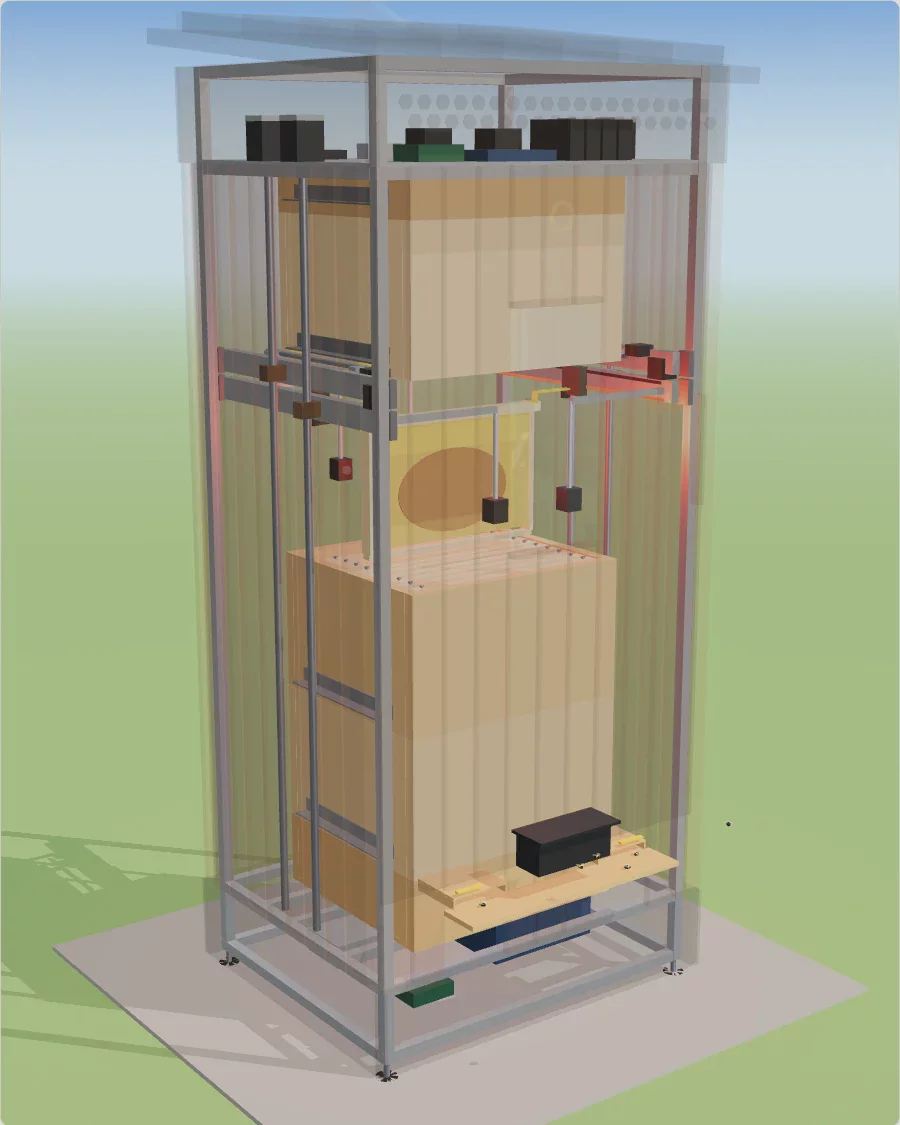
We are designing Robotic Beehive, a robotic cabinet around a standard vertical hive. It inspects the colony without opening the hive:
- lifts boxes one edge at a time to break propolis seals
- lifts each frame until its comb is centred on two cameras, one per face, for straight-on photos
- sets frames in a gap beside the working box and closes with a rolling landing
- works with any mix of deep brood boxes and shallow honey supers
- uploads photos to the web app for AI analysis and keeps a local copy
Overview
3D model
Drag to orbit, point at a part to see what it does and why it is safe for the bees, and press Play to watch the full inspection sequence. Click a step to jump to it, and use the view controls to ghost the cabinet, mix deep boxes and honey supers in the stack, pick the box to inspect, or open the service door.
Point at any part
Every component has a note: what it is, why it is there, and what it costs the bees.
The design, wiring, bill of materials and control code are open source in Gratheon/robotic-beehive: see the design document and the wiring. The hardware direction is also tracked in the robotic beehive engineering docs. The inspection workflow depends on frame side management and inspection management in the web app.
Problem focus
Out of all beekeeping issues, this product is helping with these:
Target clients
A robotic inspection platform will cost (>2000 EUR) and its main value is in digitalization and organization of the apiary state. It might be too cumbersome for 👨🏻🚒 Industrial beekeepers or 🧑🏻🌾 Farmers and too hard for 👨🏻 Potential new beekeepers. But it does look viable for:

Features
- 🍭 Automatic sugar syrup feeder
- 🎙️ 6-channel audio monitoring
- 🎮 Client-side app with UI in manual override mode
- 🎮 Connecting robot to web-app UX
- 🐝 Bee nursing video analysis
- 🐝 Bee specialization classification
- 🔊 Audio-interface to talk to bees
- 🔌 Energy autonomy
- 🔥 Hive heating
- 🚁 Ventilation control
- 🛑 Close mechanised hive entrance in case of robbing behaviour
- 🛑 Close mechanized hive entrance in case of hornet attack
- 🛑 Mechanically reduce hive entrance in case of high wind
- 🤖 Talk to bee colony with AI
- 🦀 Hive bottom scanning
- 🦾 Moveable hive bottom with varroa counting
- 🦾 Robotic frame reordering
- 🦾 Robotic insertion of new frames
- 🦾 Robotic frame isolation & extraction
- 🧪 Automatic acid treatment against varroa
Non-functional requirements
Frame extraction must not disturb the colony, expose bees to weather, or put people nearby at risk.
- Support common frame and hive section sizes (Langstroth, Farrar, National, and others)
- Protect the beekeeper and bystanders from pinch, crush, and entrapment hazards
- Protect bees: no crushing in mechanisms, no prolonged cold exposure, no theft paths through gaps
- Pull frames even when bees have propolised them shut
- Avoid fire risk from overheating, sun load, or faulty wiring (beeswax is highly flammable)
- Lift a full honey frame (about 4 kg)
- Stay repairable with modular, hot-swappable parts
- Work offline-first: readings and media available without internet or a cloud account
- Allow manual on-site control of frame movement
- Fall back to a safe mechanical state on power loss
Concept and next steps
The current concept (v3) is a static cabinet built on a 22 mm aluminium extrusion frame:
- four NEMA23 lead-screw axes and two belt shuttles, driven by Klipper firmware
- two 12 MP cameras hanging from the lift beams, so every frame, deep or shallow, is lifted until its comb is centred on them
- an NVIDIA Jetson Orin Nano for cameras and AI models
- an always-on ESP32 + LoRa supervisor for weight, climate and safety
- the Entrance Observer on the front, and a service door with a status display and emergency stop at the back, out of the bees' flight path
In simulation, a box is open for about 10 minutes. The next steps are bench tests on real hives: propolis breakaway forces, and whether one camera per face shows eggs well enough across the whole comb, while we keep focusing on the Web-app and Entrance Observer.